Wellington, Penguins, and a Little Gawp at Nature
Written by Ayesha Mu
Tuesday April 21st 2026
Category: Travel Article
Location: Wellington, New Zealand
Theme: Travel, observation
When they said Wellington would be windy, I thought hold onto your hat windy. What they meant was hold onto your whole personality windy.
Somewhere between chasing loose leaf papers down the street and tucking my windbreaker into my pants so I wouldn’t be mistaken for the Michelin Man, I realised that everything in Wellington lives on a tilt.
The palm trees along the harbour lean inland. The signposts bow slightly toward the road. Even the people walk with a practiced balance — a subtle forward angle that says, No, I will not be blown into the harbour today.
It turns out Wellington is prime real estate for wind tunnels. The city sits at the narrow waist of New Zealand, squeezed between the Cook Strait and steep green hills.
Here, air moves efficiently from high-pressure systems to low-pressure ones, accelerating as it’s funneled through tight spaces — much like putting your finger over the end of a garden hose.
The result is wind that doesn’t just pass through the city, but actively participates in it.
Walking through town feels like a game of hide-and seek with the air. Turn down the wrong alleyway and a sudden gust can stop you mid-step, the wind funneling with surprising force.
I retreat into a cosy café and ask the cashier if it’s always like this. Abbey, a lifelong local, laughs — the kind of laugh that suggests deep familiarity — and says, “It’s not so bad once you get used to it. Laundry dries in two seconds flat — just gotta peg it down real well.”
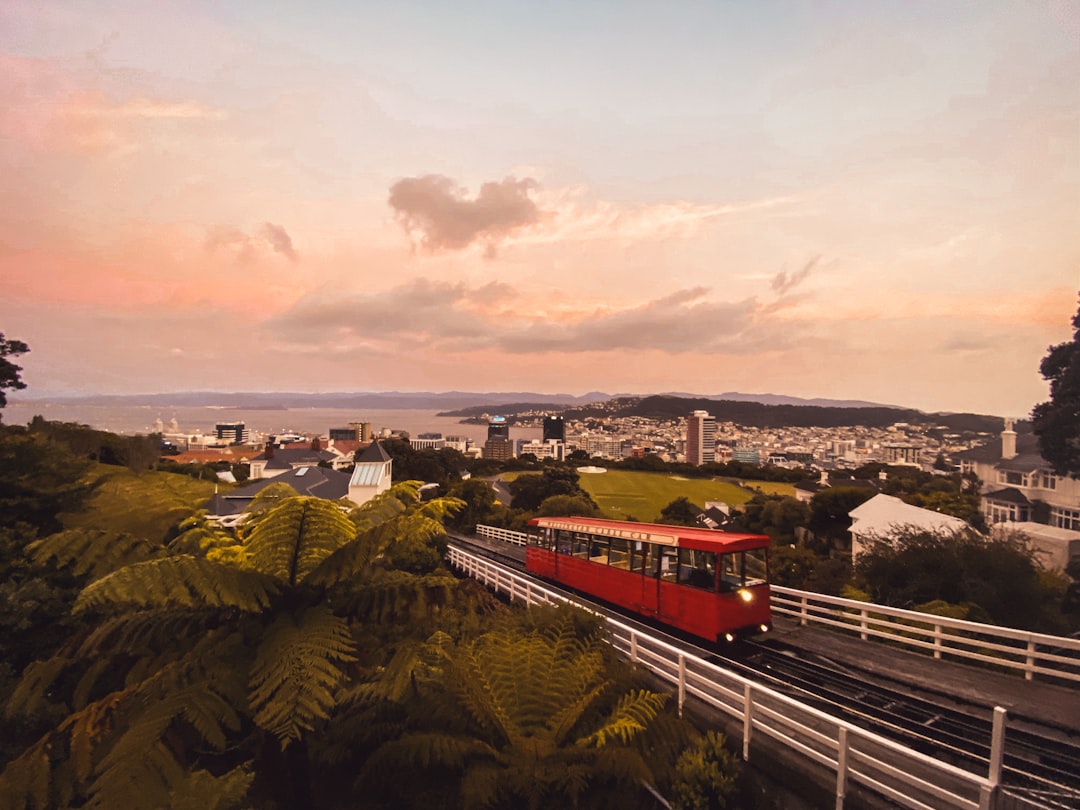
On Abbeyʼs recommendation, I take the iconic red cable car up into the hills for sunset. Established in 1902 to connect the city with hillside suburbs, it now ferries visitors between Wellingtonʼs centre and lookout points, stopping along the way for coffee refuels, wine tastings, and scenic pauses.
From the top, the city looks momentarily calm — the harbour a sheet of blue glass — though I know better by now.
As the sun sinks, the city is bathed in sherbet colours. Boats haul back into the harbour from choppy seas.
Another reason for Wellingtonʼs temperament, I discover, is a phenomenon sailors call the Roaring Forties. As global wind belts migrate from the equator and toward the poles, strong westerly winds gather and race between 40- and 50-degrees latitude. New Zealand sits squarely in this band, made even more exposed by the absence of large land masses to slow the airʼs momentum.
The next day, I travel to the Taranaki region to visit its black sand beaches. Standing atop a dark dune, I peer through my camera lens as tides drape themselves across the coastline, patient in their steady carving of the land. At low tide, the water pulls back to reveal narrow paths in the rock walls, like curtains opening on a stage.
Tucked inside these craggy divots are the nests of the native Northern Blue Penguin (Eudyptula minor iredalei), locally known as kororā — or, as Iʼd always known them, fairy penguins.
They’re the world’s smallest penguin species, standing just 25–33 centimetres tall and weighing around a kilogram. According to an information brochure, their calls are often mistaken for braying donkeys, a detail that is deeply endearing.
At dusk, the beach changes character. The iron-rich sand holds the dayʼs warmth, radiating faint heat through my boots as the sky cools and shadows stretch long. This is typically when the kororā return from the sea after a long day fishing. I returned to my car before full sun down, fighting off the mosquitoes on my short trek. I didnʼt see any waddling figures this day but I imagined them peaking around the dark curiously at me.
A day of wind and sea spray ends in a wood-fired hot tub, glass of red in hand. With the countryside and a ceiling of stars as my only witnesses, I sink down until the water reaches my chin while the wind howls gently across the hills.
Tending the fire becomes a small mathematical exercise — feeding the flames, monitoring the temperature — leaving less time than expected for stargazing. I spill wine down my front while checking the time on my phone (how long is too long in a stew pot?), laughing with only sheep-dotted slopes and the Southern Cross to notice.
Photo by Guillaume Lebelt
Leave a Reply